
Beyond the Battles: What Actually Fascinates a World War II History Buff
From Spitfires and grand strategy to Bletchley Park codebreakers, no two World War II enthusiasts are alike. Discover the three types of WWII history buffs and what actually draws them to the era.

Ask a WWII buff what they want for their birthday and watch the face go blank. This is someone who can explain exactly why Market Garden fell apart, who has opinions about the Merlin engine in a Mustang, and who once sat through a four-hour documentary on Bletchley Park without touching their phone. And yet the answer is a shrug. “Oh, nothing really. I’m fine.”
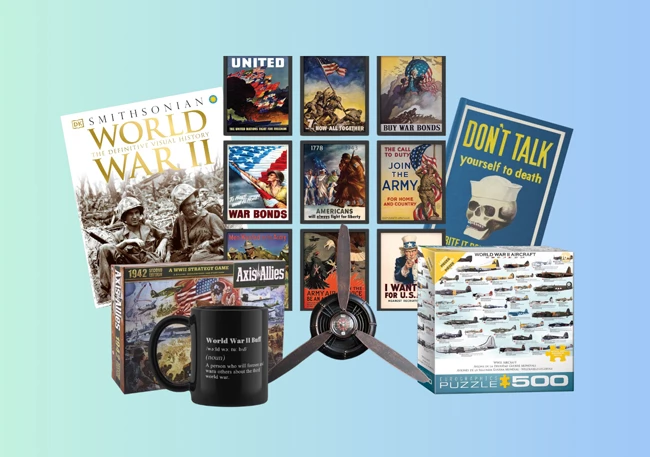
On paper, buying for a WWII history buff looks easy. There are books, models, memorabilia, historical prints, and enough documentaries to fill several lifetimes. The catch is that someone who has spent years studying the war has likely accumulated a fair amount of all that already, and another generic military-themed item won’t land the way you hope.
It helps to think about what pulled them into the subject in the first place. If you want some inspiration, my collection of World War II gifts includes designs inspired by wartime propaganda, military aviation, Churchill, and the lesser-known details of the period. Before you start browsing, though, work out which kind of history your recipient actually enjoys, because the people who love this subject tend to fall into a few camps.
Some are fascinated by the machinery of war. They know their aircraft, recognize military equipment at a glance, and can explain why one technological development mattered more than another. Part of the appeal is the engineering, and part is seeing how these machines changed the course of events.
Others are drawn to the personalities. Churchill, Roosevelt, Eisenhower, and the rest of the people who shaped the conflict are an endless source of material for anyone who likes studying leadership, strategy, and political decisions. These readers care about the people behind what happened as much as the events themselves, including the mistakes, compromises, and questionable calls that look obvious in hindsight.
A third group loves the less visible parts of the war. Codebreakers, intelligence operations, propaganda campaigns, and the enormous logistical effort behind every operation can interest them far more than yet another account of a famous battle. They like finding the machinery behind the machinery: the people and systems working quietly in the background while history happens elsewhere.
These differences matter because they change what makes a historical reference interesting. An object doesn’t need to reproduce a famous battle scene to appeal to a WWII buff. Often, a specific nod to an overlooked corner of the period goes down much better, and wartime propaganda is a good place to see why.
The posters from those years weren’t just decoration. They were built to persuade, reassure, and mobilize ordinary people for an enormous national effort. Their typography, composition, and bluntness were distinctive, and many have become instantly recognizable pieces of twentieth-century visual culture.
Norman Rockwell’s Freedom of Speech is one of the best examples. It shows an ordinary man standing up at a town meeting to speak, even though his opinion differs from everyone else’s in the room. The painting was later used in the American war-bond campaign.
That history gives a modern design inspired by the painting another layer. The Original Hottake 1943 T-shirt reworks the period imagery with a contemporary joke. Someone who doesn’t know the source sees a vintage-style graphic. A history enthusiast who recognizes Rockwell gets a second laugh.
That’s the appeal of designs built around specific historical references. The item itself can be perfectly ordinary, but the knowledge behind it makes it feel personal. It says the giver knows something about the recipient, rather than just announcing that they like history.
The same goes for items inspired by historical figures. Churchill has been depicted so many times that another conventional portrait rarely surprises anyone. A more playful take tends to stick, as long as the recipient enjoys dry humor.
The Churchill Suspected of Winning Desk Mat, for example, imagines the British prime minister in a fictional 1940 police booking photograph, charged with the suspicious offense of winning. The joke only works if you understand Churchill’s place in the war. It’s also a practical workspace accessory, so the reference earns a spot in someone’s daily routine instead of becoming one more ornament to display.
Of course, not every history enthusiast wants humor mixed into their interests. Some prefer a serious treatment, while others enjoy the occasional irreverent reference. A joke that delights a fan of historical satire can fall flat with someone who likes their history without embellishment. For that more serious crowd, the intelligence and codebreaking world is often a better fit.
Their interest usually goes well beyond famous battlefields to the cryptographers, analysts, and technicians whose work turned scraps of information into something decisive. It’s a quieter side of the war, and that’s exactly what makes it compelling to them.
The History Was Written in Code journal draws directly on that world. Its design references wartime codes and intelligence instead of leaning on the usual tanks and aircraft. For someone who loves reading about Bletchley Park, ciphers, or secret operations, that connection feels far more specific than a standard military graphic.
How someone engages with their interest day to day matters, too. Some people collect artifacts and want things to display, while others prefer things they can use. A framed print needs wall space. A notebook can sit beside whatever history book they’re reading, ready for notes. A mug becomes part of a morning routine, and a graphic tee can be worn without having to explain it to everyone they meet.
Keep this in mind if they already own a mountain of books. Adding to an established collection is hard, and another display piece isn’t always the answer. An everyday object with a clever historical nod can complement their interest without competing for shelf space.
It’s also worth separating historical authenticity from historical inspiration. Someone who collects original wartime artifacts cares deeply about provenance, materials, and strict accuracy. A contemporary design inspired by the visual language of the 1940s does something different: it celebrates an era without pretending to be a relic from it.
The best clues about what someone enjoys usually turn up in ordinary conversation. Notice which documentaries they recommend, which historical figures they keep bringing up, and whether they lean toward aircraft engineering, grand strategy, intelligence, or wartime art. Those recurring themes tell you far more than a broad label ever could.
World War II is such a vast subject that two people can spend decades studying it and end up fascinated by entirely different corners of the conflict. Whether someone is drawn to the mechanics of a plane, a coded message at Bletchley Park, or the typography of a 1943 war-bond poster, recognizing which it is turns a simple historical reference into something genuinely personal.

Dattaraj Pai
I’m the founder of Science of Gifts, a website dedicated to helping people find meaningful and thoughtful gifts. With years of experience researching the psychology of gift-giving, I explore how gifts communicate emotions, strengthen relationships, and create lasting memories.
Beyond writing about gifts, I have a background in storytelling and filmmaking, which fuels my passion for exploring the cultural impact of meaningful gestures.