

The Best Gifts for Roman History Enthusiasts
Shopping for someone obsessed with ancient Rome? This gift guide covers the best Roman history gifts.

 Contents
Some of the links on this website are affiliate links, meaning I may earn a commission if you make a purchase through those links, at no additional cost to you.
If you’re shopping for someone who gets genuinely excited about the fall of the Republic, has opinions about whether Caesar deserved it, and owns more books about ancient Rome than most libraries, you already know that a generic “history lover” gift isn’t going to cut it.
Roman history enthusiasts are a specific breed. They appreciate depth, authenticity, and the kind of detail that signals the gift was chosen for them, not just grabbed off a “gifts for history buffs” listicle. The good news is that once you know what to look for, shopping for them becomes surprisingly enjoyable.
This guide covers the best gifts for Roman history lovers across every budget. From beautifully designed wearables and home decor inspired by ancient Rome, to books that will actually get read, and conversation pieces that earn a permanent spot on their desk or shelf. Whether you’re shopping for a birthday, Christmas, or just because, there’s something here that will make any Roman history buff feel genuinely understood.
#1 The Best Overall

Quick Picks
- Best Overall Gift
- Best for Bookshelves
- Best Everyday Laugh
- Best for Beginners
- Best for Map Lovers
- Best for Readers
- Best Game Night Gift
- Best Home Decor Gift
- Best Deep Dive Read
- Best Stocking Stuffer
For the Roman history fan who wants to wear their obsession

A comfortable, history-inspired hoodie that lets them carry their fascination with Rome into everyday life.
A good Roman history gift does more than reference the period. It carries something of it. This one does that without trying too hard. Dum Spiro Spero has survived because it earns its place in every era that picks it up. While I breathe, I hope. It is the kind of phrase that does not need context to land, but means more when you already have it. Paired with the imperial eagle, the design sits closer to emblem than decoration. That distinction matters to the kind of person who knows the difference.
What I wanted when I designed this was something that actually gets worn. Not a novelty item that signals interest in Roman history once and then gets retired. It fits into a slow morning, a weekend errand, the kind of day where you are not performing anything for anyone. It becomes familiar over time, which is more than most themed gifts manage.
For someone who lives with this period rather than just visiting it, that quiet ongoing presence is the point.
For the reader who wants a sweeping yet accessible history

A clear, engaging narrative that traces Rome’s rise, transformation, and legacy across two millennia.
Most one-volume histories of Rome are really histories of the Republic and early Empire, with everything after Romulus Augustulus treated as a kind of long epilogue. Watts extends the full arc from the Iron Age to the fall of Constantinople in 1204, which means Justinian, Manuel Comnenus, and the Byzantine centuries get the same serious treatment as Caesar and Augustus. For someone who actually knows this period, that framing alone is enough to get their attention.
The approach throughout is to spotlight the personal and the dramatic rather than attempt an impossible comprehensiveness. It works. The book moves with real momentum across centuries without feeling like a catalogue of events. What makes it a strong gift for a serious reader is that it has a genuine argument. Watts maintains that Rome’s long survival came not from exceptional leaders but from systems that minimized the need for them and that thread runs through the whole book without turning it into an ideological exercise. Someone who has spent time with this period will find that thesis worth arguing with, which is exactly what a good history book should offer.
For a Roman history enthusiast, receiving this says something specific: that the person who gave it has some understanding of what they actually find interesting, not just that they like Rome.
For the history lover who enjoys small daily reminders

A themed mug that brings a touch of ancient Rome into everyday routines like coffee or tea.
Some gifts end up becoming part of a routine without you noticing, and this one did that for me almost immediately. I started using it casually, just another mug on the shelf, but the phrase “Et Tu, Decaf?” lands differently once you see it every morning. It has that mix of humor and familiarity that doesn’t wear out.
What I like is how it balances being clever without feeling overdone. It is clearly a reference, but it is not loud about it. Over time, it becomes one of those small details you appreciate more during slower mornings or while working through the day.
Since I designed this one, I paid attention to that balance. It needed to feel like something your recipient would actually use, not just something they would laugh at once and forget. As a result, it works as both a practical item and a subtle nod to Roman history, which is what makes it stick.
For the visual learner who loves richly illustrated history

A visually detailed guide filled with maps, reconstructions, and timelines of ancient Rome.
There is a version of this book that would have been purely decorative. This isn’t it. The photography and detailed maps are doing real historical work, tracing territorial expansion, military campaigns, and the physical fabric of the empire in ways that running prose rarely manages as efficiently. The CGI reconstructions of major buildings are specially commissioned, not stock imagery, and the difference is noticeable.
The spreads cover sculpture, religion, warfare, and engineering as distinct themes, which means someone with deep knowledge in one area can go straight there without the book feeling like it’s withholding. It also means a single sitting can cover a lot of ground without the structure collapsing into a catalogue.
For someone who already knows the period well, this works less as a place to learn and more as a place to look, to hold a period together spatially and visually in a way that text-heavy histories don’t offer. That’s a different kind of value, and it’s one that tends to be genuinely appreciated rather than just acknowledged. It’s the kind of thing that stays somewhere visible.
Suggested
11 Impressive Gifts for Civil War Buffs
A collection of gift idea for American civil war buffs. This gift guide brings you a list of impressive gif...
For the admirer of Rome’s vast reach and legacy

A detailed map capturing the full extent of the Roman Empire at its height.
I didn’t expect a map to hold my attention this long. The first time I looked at it, it was just about scale. Then you start noticing the details: the borders, the province names, the routes threading through terrain that hasn’t changed since legions walked it. Something you’ve spent years reading about suddenly has a shape you can take in all at once.
What it does is shift how you think about Rome spatially. Reading about Trajan’s campaigns or the logistics of the grain supply is one thing. Seeing the distances involved, the coasts, the mountain ranges that defined everything from military strategy to trade, is another. I’ve caught myself tracing regions more than once, just out of curiosity. This is the kind of decor that any history buff will want to display on their walls.
For someone who lives in this period, it’s not decoration. It’s a reference point that happens to look good on a wall. The kind of thing they’ll find themselves standing in front of mid-conversation, pointing something out.
For the history enthusiast on the move

A functional laptop sleeve with artistic Roman-themed design elements.
I put this together because I wanted something that felt like it belonged in this space without being a history lecture on a sleeve. The aquila, the columns, the amphora – the motifs are the right ones, and they’re arranged in a way that feels considered rather than cluttered. It reads as a pattern first, Roman second, which is exactly the balance that makes it wearable daily rather than just on the right occasion. It’s the kind of thing a Roman history enthusiast will actually notice. Not because it announces itself, but because they’ll recognize what’s on it and appreciate that nothing is wrong with it. No anachronisms, no Hollywood shorthand. Just the visual vocabulary of the period, handled with some taste.
For someone who carries their interests into their everyday life without making it a costume, this fits naturally. It protects something they use constantly, and it does it in a way that feels like them.
For the thinker who enjoys ancient strategy

A classic strategy game played since Roman times, focused on planning and foresight.
This game predates Rome, but the Romans took to it seriously enough that boards were scratched into flagstones at military sites along Hadrian’s Wall, soldiers killing time between postings, which is about as authentic a provenance as a game can have. Ovid mentions it. The name itself traces to the Latin merellus, meaning game piece. Calling it a Roman game isn’t wrong, it’s just incomplete.
The game itself is a genuine strategy puzzle. Simple to learn, with a rhythm that takes a few rounds to feel. The aim is to form mills, rows of three, while breaking your opponent’s, and the decisions compound quickly once both sides are placed. It doesn’t outstay its welcome. Around $30 for something with this much history behind it is an easy call. For someone who finds the period genuinely interesting, playing a game that Roman legionaries played, on the same basic board with the same rules, is the kind of detail that lands.
Suggested
The Best Viking Gifts for Norse Mythology Buffs
Discover the best gifts for Viking lovers, from Norse-themed decor to practical and fun items inspired by m...
For the admirer of Roman architecture

A decorative piece inspired by the Colosseum, capturing Rome’s architectural legacy.
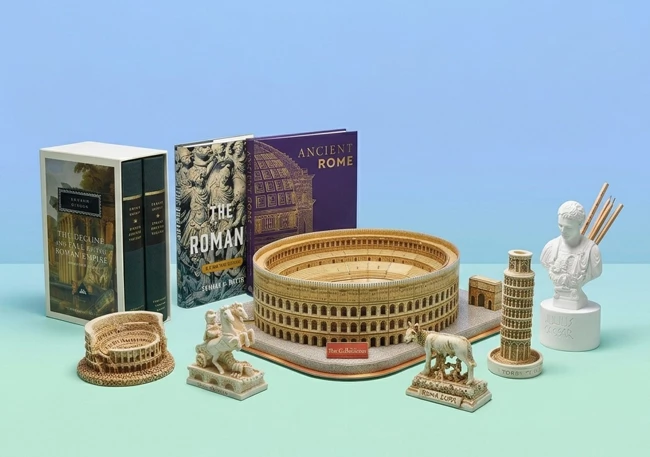
Three of the four pieces here are solidly Roman: the Colosseum, the Lupa Romana with Romulus and Remus, and a chariot. The fourth is the Leaning Tower of Pisa, which is medieval and has nothing to do with Rome. Worth knowing before gifting to someone who will absolutely notice. That said, the three that do belong together are a decent set. The Lupa Romana in particular is a good inclusion. It is one of the foundational symbols of Roman identity, and seeing it rendered as a physical object alongside the Colosseum gives the set more range than the usual single-landmark miniature. They sit on a desk or shelf without demanding attention, but they add something to a space that is clearly curated around an interest.
There is something specific about displayable gifts that makes them stick. They become part of a person’s environment rather than disappearing into a drawer, which is part of why this kind of gift tends to be remembered.
Under $25 for a set of four means the price is forgiving. For a Roman history enthusiast who appreciates the iconography and can laugh off the Pisa tower, it works. For a purist, maybe not.
For the serious reader ready for a deeper dive

Edward Gibbon’s classic, in-depth account of Rome’s fall and transformation.
There is no serious Roman history reading list that doesn’t include Gibbon. He first conceived the work while sitting among the ruins in Rome in 1764, spent the next two decades writing it, and the result remains the foundational account of the empire’s collapse more than two centuries later. That it’s still being argued with is its own kind of tribute.
What people who haven’t read him don’t expect is how readable it is. The prose is argued, opinionated, and often quietly funny. His central thesis, that Christianity played a significant role in the decline, remains contested among historians today, which means opening any volume is also an entry point into a debate that hasn’t closed.
This Everyman’s Library edition is the right way to own it: six volumes across two box sets, cloth-sewn bindings, gold-stamped covers, silk ribbon markers, acid-free paper. Built to last, which matters for a work you’ll return to rather than finish once. Around $100 for something they’ll keep for life is straightforward to justify.
Suggested

13 Coolest Gifts for World War II Buffs
A list of impressive gift ideas for World War II buffs. Tips on picking the perfect gift for a recipient ob...
For the hands-on learner who enjoys building history

A 3D puzzle of the Colosseum that combines learning with a tactile building experience.
This is a model kit as much as a puzzle. The finished Colosseum sits at roughly 13 by 10 inches, detailed enough to display, and the process of building it takes a few hours. No glue or tools required, just the pieces fitting together in sequence. What makes it work for a Roman history enthusiast specifically is that building it forces a different kind of attention than reading about it. The tiers, the arches, the way the structure repeats and compounds around its full circumference – you come away with a clearer sense of the engineering than any photograph gives you. A National Geographic booklet on the Colosseum is included, which is a decent addition rather than an afterthought.
Fair warning: the assembly instructions have a reputation for being hard to follow. Patient builders won’t mind, but it’s worth knowing. If the person you’re buying for enjoys the process of figuring things out, that’s part of the appeal. If they prefer things to go smoothly, maybe not.
For someone who loves both Roman history and the satisfaction of building something with their hands, this sits at a good crossover. It also makes a natural companion to a broader interest in puzzles and models.
How to Pick the Right Gift
Start with how they engage with the subject. A Roman history enthusiast who reads widely is a different gift target than one who loves the aesthetic of the period or enjoys hands-on activities. Getting this right matters more than finding something impressive on paper. For readers, match the gift to their depth. Someone still building their knowledge will appreciate a well-written narrative history. Someone who already owns the essentials wants something more specific: a focused study of a particular period, figure, or debate they haven’t yet explored. When in doubt about their level, go for something with strong writing over something with strong credentials.For visual or tactile learners, maps, models, and display pieces tend to land better than books.
These work especially well if you’re not certain how deep the interest runs, since they reward curiosity without demanding it. Practical gifts with a Roman angle, everyday items they’ll actually use, carry the sentiment further than decorative pieces that get admired once and shelved. The more a gift fits into someone’s daily life, the longer it stays present.If they’re the kind of person who likes to engage actively with history rather than just consume it, games and puzzles that have genuine historical grounding are worth considering. There’s a meaningful difference between a Roman-themed product and one that connects to how people in that period actually lived.
What to Avoid
The main risk with this audience is anything that signals you didn’t look closely. Roman history buffs notice detail, and a gift that gets something wrong, mixed timelines, muddled symbolism, a design that blends Greek and Roman iconography carelessly, reads as an afterthought regardless of the price.
Avoid cheap themed merchandise that leans on surface aesthetics. If the Roman connection is just a logo or a vague ancient motif, it probably won’t land. The same applies to novelty items that treat the subject as a costume rather than a civilisation. Be careful with books unless you have a clear sense of what they already own and how they read. A dense academic text given to someone who prefers narrative history feels like homework. A popular overview given to someone with serious knowledge can feel condescending. If you’re uncertain, check what’s already on their shelf, or choose a beautifully produced edition of something canonical rather than guessing at a title.
Purely decorative pieces without substance are also worth skipping. Small, low-quality figurines or generic poster prints tend to disappear into a room rather than earning a place in it. If you’re going decorative, go for something with enough presence to justify the wall or shelf space.
When in doubt, simpler and better made beats elaborate and cheap. This is a subject people take seriously. The gift should reflect that.

Dattaraj Pai
I’m the founder of Science of Gifts, a website dedicated to helping people find meaningful and thoughtful gifts. With years of experience researching the psychology of gift-giving, I explore how gifts communicate emotions, strengthen relationships, and create lasting memories.
Beyond writing about gifts, I have a background in storytelling and filmmaking, which fuels my passion for exploring the cultural impact of meaningful gestures.