




Why Psychology Students Keep Getting the Wrong Psychology Gifts
Psychology students spend years learning how complicated human behavior is, only to receive another Freud mug for their birthday. A look at academic stereotypes, inside jokes, and why knowing someone's degree doesn't necessarily mean knowing their interests.

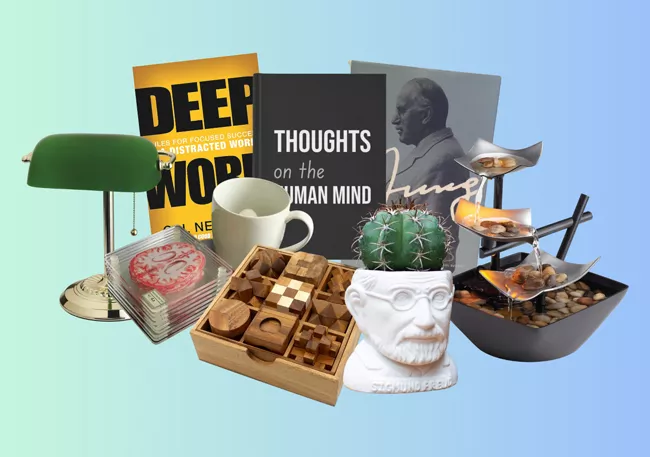
Somewhere right now, a psychology student is unwrapping a Freud mug. It came from a relative who remembers two things about the degree: it involves the mind, and Freud had a beard. The mug has a joke about analyzing people, or a cartoon Freud looking smug. The student says thank you, and the mug joins the shelf with the brain-shaped stress ball, the inkblot notebook, and whatever else says “psychology” to people who haven’t studied it. It’s a perfectly nice mug. But a few years spent learning how tangled human behavior really is, and the world hands you back a bearded Austrian and a cartoon brain.
Most people can name Freud and not much else. He’s the couch, the dreams, the childhood. Jung gets a mention sometimes, and Rorschach if the conversation runs long. Meanwhile, the student in cognitive neuroscience is looking at brain imaging data. The developmental student is working out how toddlers pick up language. Everyone else is knee-deep in research methods and statistics. Freud turns up in one history lecture, and he is not the reason anyone is awake at 2 a.m.
Tell someone you study psychology and the questions arrive on schedule. Can you read minds? Can you interpret this dream I had about my teeth? Are you analyzing me right now? Usually it’s friendly curiosity, but it assumes a superpower. The reality is that you spent the afternoon staring at a statistical output, trying to work out why your hypothesis wasn’t supported. Understanding the human mind turns out to involve a lot of spreadsheets.
Gift shopping runs on the same shortcuts. The medical student gets a stethoscope-shaped something. The writer gets a notebook with a quote about writing on the cover. The filmmaker gets a tiny clapperboard, as if they might forget what they do for a living. These can be sweet, but they’re the giver grabbing the nearest symbol. Someone drawn to forensic psychology doesn’t necessarily want what a memory researcher wants, and neither of them may feel anything for a novelty Freud with a cigar. Same degree title. Possibly nothing else in common.
Psychology does have good material for gifts once you get past the famous names. Hermann Ebbinghaus ran memory experiments on himself, memorizing lists of nonsense syllables and testing how much he’d lost. His work gave us the forgetting curve, the graph of how fast information fades after you learn it. Psychology students study that curve, understand perfectly why they should review their notes, and then can’t remember yesterday’s lecture. Knowing the science doesn’t soften exam season at all. That gap is what the Ebbinghaus forgetting curve desk mat is built around, with the line “I Studied This Yesterday” across it. It’s a joke about a graph, but mostly it’s about knowing exactly why you’ve forgotten something and being unable to do anything about it.
Elizabeth Loftus gave me another one. Her research showed that memories can be altered by information that arrives after the event. In a well-known study with John Palmer, participants watched footage of car accidents, and changing a single verb in the question changed their estimates of how fast the cars were going. Some later remembered broken glass that was never there. I couldn’t stop thinking about a government department that investigates dubious memories and sends them back to their owners with official paperwork. That became the Memory Restoration Bureau, with the disclaimer “Your Recollection May Vary.” You don’t need to know the experiment to enjoy the joke, though knowing it makes the Bureau feel even less qualified.
An obscure reference isn’t automatically a better present, though. Someone hears a friend is studying statistics and buys every joke about significance they can find. Maybe the friend loves them. Or maybe they’ve lost three weeks to a research project and would rather not be reminded on their birthday. A literature student can adore novels and loathe literary theory. A history student can be obsessed with Rome and bored senseless by the Tudors. A history student can be obsessed with Rome and bored senseless by the Tudors. A major tells you very little about which parts someone actually likes.
Often, the real appeal has zero to do with any textbook theory. Psychology students develop their own sense of humor, mostly because they keep catching themselves doing the things they’re studying. They can explain procrastination in technical terms while procrastinating. They’ll call out a cognitive bias in a casual argument instantly, only to go dead silent when someone spots it in theirs. A clever jab at executive dysfunction doubles as a precise snapshot of their chaotic desk. It lands because they’ve lived the course, and it would mean very little to anyone who hasn’t.
So how do you find out what matters to a particular student? Ask which classes they’ve enjoyed, or what they’re working on, or why they just spent twenty minutes on an experiment you’d never heard of. Listening to them complain about assignments is surprisingly useful, too. Someone fascinated by eyewitness memory might love a Loftus reference. Someone who’s sick of research methods might want something with no connection to statistics whatsoever. You don’t need to analyze them just to pick out a gift. They’d probably prefer you didn’t.
What I’d suggest is paying attention to what someone talks about, not just what their degree says. A notebook, a sweatshirt, or something funny for their desk might be exactly right. I’ve put those in my guide to gifts for psychology majors alongside the more specialized picks. Not every present has to prove you understand cognitive psychology, least of all when the recipient spends most of the week trying to understand it themselves.
And I wouldn’t be too hard on the Freud mugs. Some students genuinely like the history, and some just enjoy having Freud glare at them over morning coffee. A quick symbol rarely captures the actual work. You can spend ages hunting for something tied to a degree and still miss the part they actually care about. Then again, if they’re writing their dissertation on Freud, the mug is a safe bet.

Dattaraj Pai
I’m the founder of Science of Gifts, a website dedicated to helping people find meaningful and thoughtful gifts. With years of experience researching the psychology of gift-giving, I explore how gifts communicate emotions, strengthen relationships, and create lasting memories.
Beyond writing about gifts, I have a background in storytelling and filmmaking, which fuels my passion for exploring the cultural impact of meaningful gestures.