

What Makes a Gift Feel Personal (Even If It Isn’t Custom)
What makes a gift feel personal even without customization? A closer look at the subtle details that make gifts feel thoughtful and specific.

There’s a quiet kind of magic in receiving a gift that feels like it was chosen just for you, even when it clearly wasn’t custom-made. No initials engraved, no photo printed on it, nothing that screams “this was personalized.” And yet, somehow, it lands. It feels specific. It feels seen.
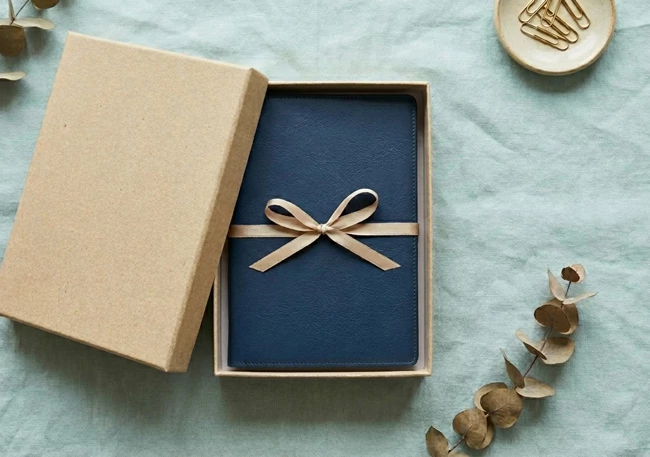
When I was in college, my girlfriend at the time gave me a fairly ordinary notebook (I assume because of my aspirations of becoming an author). Plain cover, muted color, the kind you could pick up in under a minute at any store. But inside the front page, she had written a single line: “For the ideas you don’t say out loud.” That was it. No long message, no elaborate gesture. Still, it felt oddly precise. I used that notebook more carefully than any expensive planner I’ve owned.
It made me realize something slightly uncomfortable. The “personal” part of a gift often has very little to do with the object itself.
There’s research that gets close to this idea. Studies in behavioral psychology, including work from researchers like Ryan Howell and others studying experiential versus material gifts, suggest that people value gifts that reflect understanding over sheer cost or uniqueness.1
Not understanding in a grand, obvious way. More like a quiet recognition. The kind that says, “I’ve been paying attention, even when it didn’t look like it.”
That attention can show up in small ways. A coffee mug that fits someone’s oddly specific preference for large handles. A book that aligns with a phase they’re going through, not just their general interests. It’s rarely about the category. It’s about timing and nuance. You could give the same item to two people and have it feel deeply personal to one and completely generic to the other.
There’s also something about restraint. Over-customized gifts sometimes try too hard. They close off interpretation. A T-shirt with someone’s face on it or a hyper-specific inside joke printed in bold can feel more like a performance than a gesture. It tells the recipient exactly how they’re supposed to react. Subtle gifts leave a bit of space. They let the person meet the gift halfway.
Another thing that matters, though people don’t always admit it, is effort that doesn’t look like effort. Not in a showy way. Just enough friction to suggest intention. Psychologists call this the “effort heuristic” in some contexts. People tend to assign more value to things that appear to have required thought or care. Not necessarily time, but attention. Even something as simple as choosing a version of an item that fits better, looks better, or feels more aligned can shift how it’s received.
And then there’s memory. Not nostalgia in the obvious sense, but small callbacks. A snack you once mentioned liking months ago. A color you tend to gravitate toward without realizing it. These are easy to miss unless someone is quietly collecting data over time. When those details show up in a gift, it creates a kind of echo. It says, “That thing you said once didn’t disappear.”
It’s interesting because, on the surface, none of this requires customization. No algorithms, no personalization tools, no added features. If anything, too many options can get in the way. When everything can be customized, the baseline expectation shifts, and the gesture starts to feel transactional. Like filling out a form.
What people seem to respond to instead is recognition without announcement. A gift that doesn’t explain itself too much. One that feels like it belongs to them, even if it could technically belong to anyone.
There’s a slight risk in that approach. It’s easier to get wrong. You’re relying on judgment rather than formulas. But when it works, it works in a way that’s hard to replicate with something louder or more obviously tailored.
And maybe that’s the point. A personal gift isn’t always about making something unique. It’s about making someone feel understood, briefly and without a lot of fuss. Sometimes all it takes is a notebook and a single line written in the right tone, at the right time.

Article Sources
1. Zhang, Jia Wei, et al. Damned if they do, damned if they don’t: Material buyers are not happier from material or experiential consumption. Journal of Research in Personality 50 (2014): 71-83.

Dattaraj Pai
I’m the founder of Science of Gifts, a website dedicated to helping people find meaningful and thoughtful gifts. With years of experience researching the psychology of gift-giving, I explore how gifts communicate emotions, strengthen relationships, and create lasting memories.
Beyond writing about gifts, I have a background in storytelling and filmmaking, which fuels my passion for exploring the cultural impact of meaningful gestures.