

Why Smart People Give Bad Gifts (The Empathy Gap)
Gift giving psychology explains why we keep buying for ourselves instead of the recipient. Here's what research says is really going on.

Most bad gifts are given with complete confidence. That’s what makes them interesting. Doubt would be useful here. Doubt would send someone back to the drawing board, or at least to a different shelf. But there is no doubt. They pick something up, feel a small flutter of recognition (yes, this is perfect) and walk to the register without a second thought. The gift gets wrapped. It gets presented. And somewhere between the ribbon and the thank-you, something goes slightly wrong. The recipient smiles, but the smile is just a little too composed. The gift ends up in a drawer.
This is not a story about bad taste. Most people who give bad gifts are not thoughtless. They are, in fact, thinking quite hard. The problem is what they’re thinking about.
Psychologists have studied something called the empathy gap, originally in the context of hunger and pain. People who aren’t hungry, it turns out, dramatically underestimate how much hunger shapes someone’s choices. But the same thing happens when we try to imagine what another person wants. We know, intellectually, that they have different preferences. But when we actually try to simulate those preferences, we keep accidentally simulating our own.
Call it the Version-of-You trap. When you’re stuck on what to get someone, your brain quietly substitutes a slightly modified version of yourself and asks: what would I want, if I were them? The modification is usually pretty shallow. You might adjust for the fact that they like gardening, or that they’re older than you, or that they’re a woman and you are not. But the base template (your aesthetic, your values, your whole relationship with objects) stays stubbornly in place. This is why fathers who love tools give tools. Why people who believe in self-improvement give books about self-improvement to people who have no interest in changing anything about themselves. Why someone who finds scented candles deeply luxurious will give those same candles to a person who finds fragrance overwhelming and slightly aggressive.
Research by Francis Flynn and Gabrielle Adams suggests that givers and receivers evaluate gifts by different criteria entirely.1 Givers focus on the moment: what will look thoughtful, what signals effort, what makes a good impression at the table. Receivers care more about whether they’ll actually use the thing. They will quietly resent an impractical gift, even a beautiful one, in ways the giver never anticipated, because the giver wasn’t really imagining the gift in the recipient’s daily life. They were imagining the unwrapping.
This explains a lot. It explains why experiential gifts tend to land better than objects, even though objects feel more substantial when you’re standing in a store. An experience lives in memory. An object lives on a shelf, accumulating a faint sense of obligation. It also explains the strange guilt people feel about giving gift cards, which recipients, in study after study, actually appreciate more than most alternatives. The recipient gets exactly what they want. The giver feels like they’ve copped out. Both reactions are psychologically real. Both are also, in their own way, kind of missing the point.
What’s harder to say out loud is that the empathy gap isn’t purely cognitive. It’s also emotional. Gifts are representations. A gift says: this is how I see you. And so we give things that reflect how we want to see the other person, or how we’d like them to see themselves, rather than who they actually are right now.
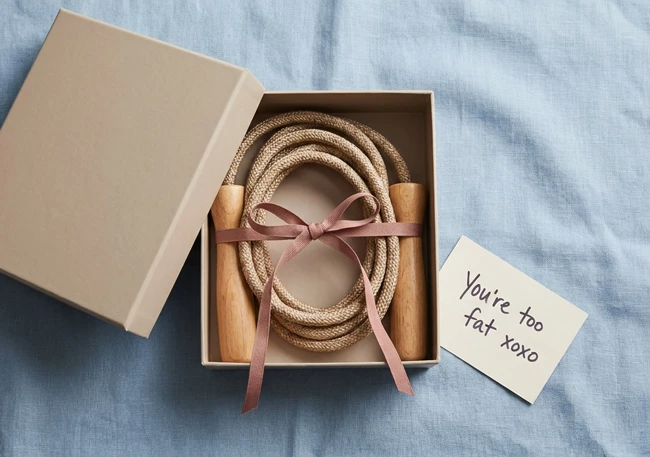
There’s a story (the kind that circulates in family lore long after anyone finds it funny) about a woman who gave her sister workout equipment every year for a decade. Resistance bands. A foam roller. A jump rope. The sister never used any of it and had no particular interest in fitness. When someone finally asked about the pattern, the giver said, with complete sincerity, “I just think she’d feel so much better if she got into exercise.” She wasn’t giving her sister what her sister wanted. She was extending a standing invitation to become someone else. The sister had been politely declining for ten years.
I’ve done this too, though I managed to make it awkward in under thirty seconds. I once gave a friend a book on cinematography, the kind I’d worn the spine off, annotated in three colors, recommended to everyone I considered serious about the craft. He was a professional cinematographer. Had the credits and everything. I had just, somewhere along the way, decided he wasn’t really a student of it. So I handed him the book like I was filling a gap. He looked at it, then at me, and said, very politely, “Do you think my skills aren’t good enough?” I told him no, of course not, it’s just a great book. He nodded. We moved on. But the question hung there for the rest of the evening, because it was the right question. I hadn’t given him a book. I had given him my private assessment of him, wrapped in a cover he didn’t ask for.
This kind of aspirational gifting is extremely common and almost never acknowledged. We give people things for the person we imagine they could be, or the interest we secretly hope they’ll develop, or the version of their life we find more appealing than the one they’re living. It feels generous. It is, in a strange sense, a form of care. But it tends to land as tone-deaf at best.
The fix sounds obvious: just ask. And yes, asking helps. Wishlists exist for exactly this reason, and research shows that gifts chosen from a list are appreciated more, not less, despite the common anxiety that a requested gift lacks feeling. But asking doesn’t fully solve the problem, because the empathy gap isn’t only about not knowing what someone wants. It’s about the quiet resistance to knowing, the way our brains default back to ourselves even when better information is sitting right there.
Here’s where it gets genuinely interesting. Studies on perspective-taking suggest that our mental simulations improve not when we try harder to imagine being someone else, but when we gather more concrete, specific information about their actual life. “I know she likes reading” is a category. “I know she reads on her lunch break and has been tearing through thrillers and hates ambiguous endings” is a person. The more specific the picture, the less room there is for your own preferences to sneak back in. The detail crowds out the projection.
Good gift-givers, as a result, tend to be good noticers. Not necessarily more empathetic by temperament, just attentive. They remember a throwaway comment from four months ago. They notice what someone uses versus what they own but never touches. They file things away without meaning to. It’s less about emotional intelligence and more about keeping your eyes and ears reasonably open throughout the year, rather than trying to conjure a brilliant insight three days before someone’s birthday while staring at a website.
There’s also a subtler version of the empathy gap that doesn’t get discussed much: the social performance layer. Gifts happen in front of people. Or get reported to people. So the choice gets shaped by an invisible audience. We give things that will read as thoughtful to others, that perform giftness convincingly, even when the recipient would actually prefer something that doesn’t photograph well. This is how people end up receiving elaborate charcuterie boards from someone who doesn’t know what they actually like to eat. The gift is legible. It just doesn’t know the person.
None of this is an argument for purely transactional giving. There’s a real pleasure in being known, in receiving something that someone picked because it reminded them specifically of you, something you didn’t know you wanted until it was in your hands. That kind of gift is rare precisely because it requires someone to have been paying attention in a way that most of us, caught inside our own heads, rarely manage. It shows that you’ve put in the effort into picking the gift, which matters more than the price tag. When it happens, it feels like being seen. Actually seen.
The empathy gap doesn’t close entirely. It’s structural, baked into how minds work. But it narrows considerably when you stop asking “what would I want?” and start asking “what do I actually know about this person?” The answer is usually simpler than you’d expect. And almost certainly not a foam roller.

Article Sources
1. Flynn, F.J., and Adams, G.S. Money Can’t Buy Love: Asymmetric Beliefs About the Link Between Gift Price and Feelings of Appreciation. Journal of Experimental Social Psychology, vol. 45, no. 2, February 2009, pp. 404–409.

Dattaraj Pai
I’m the founder of Science of Gifts, a website dedicated to helping people find meaningful and thoughtful gifts. With years of experience researching the psychology of gift-giving, I explore how gifts communicate emotions, strengthen relationships, and create lasting memories.
Beyond writing about gifts, I have a background in storytelling and filmmaking, which fuels my passion for exploring the cultural impact of meaningful gestures.