

The Role of Identity in Gift-Giving
Why some gifts land and others don’t. This piece explores the role of identity in how we give and receive gifts.

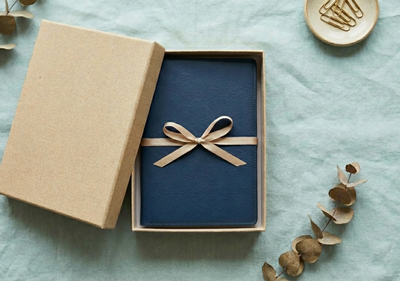
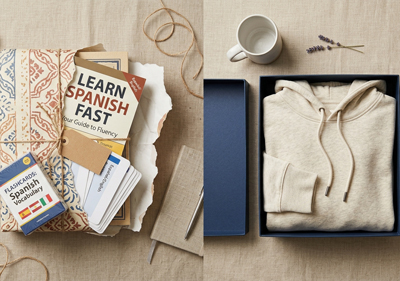
There’s a whole category of gift that doesn’t describe who someone is. It describes who they’ve mentioned wanting to be. A cooking book for a foodie who wants to cook but never does. A guitar for someone who always wanted to learn. Journal for an aspiring writer. Thoughtful, technically. Also a little presumptuous. Because now the recipient has to decide whether to accept the version of themselves you just handed them.
Some people love that. Others never open it. Or, more commonly, put it on a shelf where it joins a small graveyard of good intentioned gifts. Unless a burglar finds it someday. Hopefully one who’s always wanted to nail a proper shakshuka.
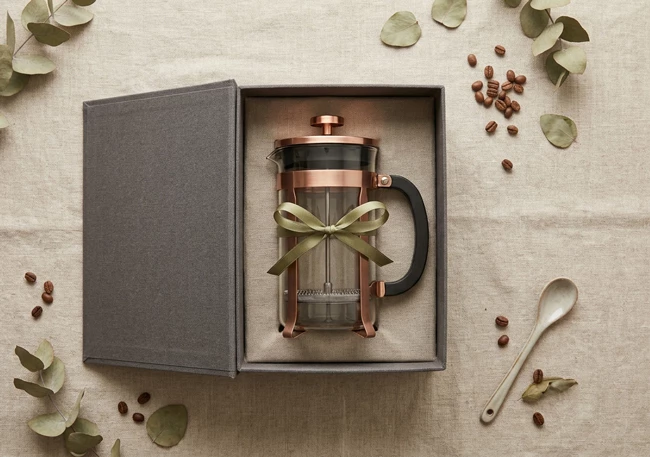
I once gave a friend a French press. A good one, heavy glass, the kind that requires a small ritual to use. I had this image of him as a slow-morning person. He’d mentioned once, maybe twice, that he wanted to “get into proper coffee.” That was enough for me to build an entire identity around it. Someone who’d grind the beans, wait the four minutes, actually wait. He thanked me, put it on the counter, and for about a week it looked great there. Then I noticed the Nespresso pod sitting next to it. Then another. He never said anything. Neither did I. He’s a pod person. Has been the whole time. I just didn’t want him to be.
Psychologists sometimes talk about identity as something that’s both stable and in motion. There’s the “actual self,” who you are right now, and the “ideal self,” who you’re trying to become. Gifts tend to land best when they sit somewhere between those two. Not too far ahead, not too far behind.
 Research
A 2025 study in the Journal of Experimental Social Psychology found that gifts act as reflected appraisals: they signal how the giver sees the recipient, and that shapes how recipients see themselves. Psychologists call the underlying mechanism self-concept clarity: how firmly someone knows who they are. The stronger that sense of self, the more a gift either lands or doesn’t.1
Which is why a bad one can feel oddly personal. It usually is.
It explains why a carefully chosen book can feel intimate, while a generic luxury item can feel oddly hollow. The book says, I see what you care about. The luxury item says, I hope this is enough.
There’s also a signaling aspect to gifts that runs both ways. When you give something, you’re not just expressing your understanding of the recipient. You’re also revealing something about yourself. Your taste, your attention, your assumptions. In a way, every gift is a small piece of self-presentation. You’re saying, this is how I see you, and this is the kind of person I am for seeing it.
That might be why some gifts feel slightly uncomfortable, even when they’re objectively nice. They carry an identity that doesn’t quite fit. Think of the overly ambitious self-improvement gift. The fitness tracker for someone who has never mentioned wanting to track anything. The productivity planner for someone who resists structure on principle. These gifts often come from a good place, but they can feel like a suggestion disguised as generosity. A nudge toward a different version of the self. A good gifts fits into the existing routine, upgrades what is already part of their life.
Research on “miscalibrated gifts” touches on this. Givers tend to focus on desirability, what would be impressive or ideal, while recipients lean toward feasibility, what actually fits into their current life.
ResearchResearch on gift-giving consistently finds that givers and recipients want different things. Givers optimize for the moment of opening, for something impressive, something that lands. Recipients think about ownership. How useful it is. How much it actually fits into their life. Psychologists call this the desirability-feasibility gap, and a 2014 study in the Journal of Consumer Research found it holds up across gift types and occasions. Most givers never think to ask the feasibility question. They’re too focused on the reaction. 2
The gap isn’t just practical. It’s identity-based. You’re not just asking, will I use this, but am I the kind of person who uses this? And people are surprisingly protective of that boundary.
At the same time, identity isn’t rigid. It has edges. People experiment. They try on new versions of themselves, sometimes quietly. That’s where gifts can do something more interesting. Not just reflect identity, but gently expand it.
A good example is when someone gives you something that feels slightly off at first, but then grows on you. A hoodie in a color you’d never pick for yourself. A hobby you hadn’t considered. If it’s close enough to your existing sense of self, it can act as a kind of bridge. You step onto it almost without noticing. One day you reach for the hoodie without thinking, and somewhere in that small moment, it became yours.
People don’t just express identity through objects. They also shape it. Wearing a lab coat, for instance, can make people perform better on attention-related tasks if they associate it with intelligence and precision. It’s a small shift, but it hints at something larger. Objects can carry identities into us, not just out of us.
That’s part of the quiet optimism in gift-giving. You’re not only saying, I see you. You’re also saying, here’s a version of you I think you might like.
Of course, that only works if the suggestion feels respectful. Too big a leap, and it feels like a misread. Too safe, and it feels forgettable. The sweet spot is usually somewhere in the adjacent territory, close enough to what someone already loves to feel considered, specific enough to feel like you actually thought about it. A Civil War buff doesn’t just want anything historical. They want something that speaks to exactly that obsession. There’s no formula for this, which is probably why people overthink it.
Identity also has a social layer. We don’t just have a sense of self in isolation. It’s tied to groups, roles, affiliations. The runner, the film buff, the new parent, the person who just moved cities and is still figuring things out. Gifts that connect to these identities often feel more grounded because they acknowledge context.
I remember giving someone a simple map print of a city they had just left. It wasn’t expensive or particularly rare. But it captured something specific. A version of their life that had just ended. They spent a long time looking at it, tracing streets with their finger, pointing out places I had never been. It wasn’t about the object itself. It was about recognition. You knew this mattered to me.
There’s research on nostalgia that fits here, showing that reminders of meaningful past experiences can increase feelings of social connectedness and continuity of self. A gift can act as a small anchor, tying together who someone was and who they are now.
Then there’s the opposite case. Gifts that ignore identity entirely. The kind you give when you don’t know the person well, or don’t have the time to think. Gift cards, generic sets, things that are technically useful but emotionally blank. These aren’t failures, exactly. They serve a purpose. But they rarely create that moment, the glance, the quiet check for recognition.
Interestingly, studies on gift-giving often find that givers overestimate how much novelty and surprise matter, while recipients place more value on familiarity and personal relevance. It’s another version of the same pattern. Identity over spectacle.
There’s also a small, almost funny mismatch that happens with identity and aspiration. People like gifts that align with who they think they are, but they also like gifts that affirm how they want to be seen by others. This can lead to situations where someone loves a gift publicly but never uses it privately. The object works as a signal, even if it doesn’t fit their day-to-day life.
You see this with things like statement pieces, or items tied to high-status identities. The expensive camera that rarely leaves the bag. The elaborate cooking equipment used once and then carefully stored. These gifts aren’t entirely wasted. They serve a different role. They help construct a narrative about the self, even if that narrative isn’t fully lived.
It’s easy to be cynical about that, but it’s also very human. Identity isn’t just about accuracy. It’s about storytelling. If there’s a pattern in all this, it’s that good gifts tend to feel like they belong. Not just in someone’s home, but in their sense of who they are. They don’t create friction. They don’t ask for a personality shift. They fit into the existing story, or extend it just a little.
And when they don’t, the reaction is usually subtle. A polite thank you. A brief moment of appreciation. Then the object drifts to the edge of life. Not rejected, just not absorbed.
Which brings things back to that moment after the wrapping paper is gone. The glance. It’s not a test you can fully pass. People are complicated, and so are their identities. But it’s still the right question to have in mind.
Not what should I give. Not even what would they like.
But who are they, really. And how much of that can I see.

Article Sources
1. Schwartz, Barry. The social psychology of the gift. American journal of Sociology 73.1 (1967): 1-11.
2. Baskin, E., Wakslak, C. J., Trope, Y., & Novemsky, N. (2014). Why Feasibility Matters More to Gift Receivers than to Givers: A Construal-Level Approach to Gift Giving. Journal of Consumer Research, 41(1), 169–182.

Dattaraj Pai
I’m the founder of Science of Gifts, a website dedicated to helping people find meaningful and thoughtful gifts. With years of experience researching the psychology of gift-giving, I explore how gifts communicate emotions, strengthen relationships, and create lasting memories.
Beyond writing about gifts, I have a background in storytelling and filmmaking, which fuels my passion for exploring the cultural impact of meaningful gestures.