

The Best Gifts for Soccer Players
Not sure what to get a soccer player? These picks were chosen around one question: what actually gets used, kept, or noticed long after the occasion is forgotten.

 Contents
Some of the links on this website are affiliate links, meaning I may earn a commission if you make a purchase through those links, at no additional cost to you.
Most gifts for soccer players follow the same logic: find something with a ball on it, or a jersey, or cleats if you’re feeling ambitious. The problem isn’t taste. It’s that the giver is thinking about the moment of opening rather than the weeks and months that follow. A gift that photographs well at the table and then disappears into a drawer is still a miss, even if nobody says so.
What actually sticks tends to fall into one of two patterns. Some things enter the routine so quietly that the person stops thinking of them as gifts at all. Others don’t really get used so much as kept, a book that ends up recommended to three other people, a personalized piece that just finds its spot in the room. The middle ground, the thing bought with good intentions that doesn’t quite fit either category, is where most well-meaning gifts end up.
The picks here were chosen with that in mind. Some are purely functional, built for the training grind. Others are quieter, meant to sit somewhere and be noticed occasionally. The thread connecting them is that each one has a reason to still be around six months from now.
#1 The Best Overall

Quick Picks
- Best everyday hoodie they'll actually wear
- Best subtle, identity-based t-shirt
- Best practical gear for daily use
- Best functional gift with a sense of humor
- Best for training days and warm-ups
- Best for improving skills in a fun way
- Best for players who study the game
- Best for fans who love the stories behind soccer
- Best personalized gift that feels thoughtful
- Best comfort gift with a personal touch
Buying for a soccer player sounds simple until you realize how particular they can be about their gear. Whether you’re shopping for a teen, a boyfriend, or someone who’s been playing for years, the same principle applies. Some things get used every day. Others end up forgotten in a bag.
A quick way to think about it:
How to choose a gift for a soccer player
Figure out how seriously they play first. A training aid is perfect for one person and pointless for another. A gift for a teen soccer player looks different from one for an adult who trains five days a week.
Think about what they’d buy themselves but keep putting off: grip socks, a pressure gauge, a decent recovery tool. Find what you can upgrade for them.
Soccer players are attached to the sport as part of their identity. A gift that reflects that lands better than something just functional, whether you’re buying for a boy, a girl, or someone who just lives for the game.
What to avoid when choosing a soccer gift
Skip the generic bundle kits. Cones, ball, pump in a mesh bag. Serious players have it. Beginners don’t need it yet.
Don’t guess on cleats. Sizing varies, fit is personal, and players are picky.
Avoid club jerseys unless you know exactly which team they support and that they actually wear merch.
No novelty stuff that treats soccer like a punchline. They probably love this sport more than you realize.
Once you get this right, the rest becomes easier. Here are some gifts that tend to land well.
For the player who lives in the game, even off the pitch

A clean, structured hoodie that feels like it belongs to the game without relying on loud graphics
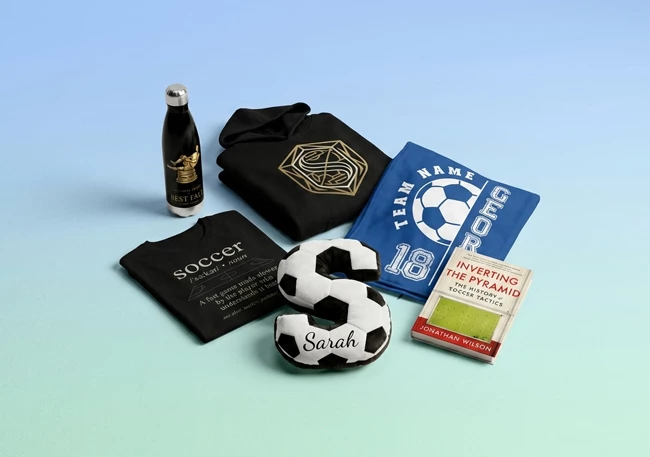
Most soccer gifts lead with the sport before they consider the person. The oversized graphic, the club colorway, the jersey that comes out twice a year. This one doesn’t. The crest is geometric and quiet, the kind of design someone notices up close rather than across the room, which is part of why it actually gets worn.
Hoodies live in rotation in a way that most gifts don’t. Grabbed before early sessions, thrown on after training, worn on the drive home when nobody’s thinking about what they’re wearing. A hoodie that fits that rhythm without feeling like a costume earns its place fast. This one does.
It’s the pick for someone who plays regularly and has taste they’d never describe out loud. Not a fan piece. Not a statement. Just something they’ll reach for without thinking, and eventually not remember a time before they had it.
For the player who understands the game, not just plays it

A definition that only makes sense if you actually play the game
There’s a specific kind of soccer player this works for. Not the one who just shows up and runs. The one who watches film, has opinions about pressing systems, notices things other people on the pitch don’t. A gift that speaks to how someone thinks about the game, not just that they play it, lands differently.
The design doesn’t shout. It reads like an inside joke that only makes sense if you actually get it, which is most of the point. Gifts built around identity tend to get worn more than gifts built around fandom, because they reflect something the person already believes about themselves. (There’s a reason identity-based gifts feel more personal even when they aren’t custom-made.)
At $24, it’s also the kind of gift that doesn’t require much justification. Easy to give, hard to get wrong, assuming you know the person well enough to know this describes them.
For the player who's always carrying their game with them

A backpack built for the training schedule, not just the match day
Bags are one of those gifts that sound boring until you give someone a good one. The player who’s moving between school, training, and weekends doesn’t need another piece of soccer-branded stuff. They need something that actually holds everything without falling apart by spring.
What I like about this one is that it doesn’t try to do too much visually. No loud logos, no unnecessary details. Which makes it look more premium. Just a well-built bag that fits into a routine without asking for attention. That’s harder to find than it sounds. Most gear gifts get evaluated once and then assigned a permanent spot. A bag that works gets picked up every single day.
It’s the kind of gift that fits someone whose life is already in motion. If you’re choosing for a player who lives around their sport rather than just showing up for it, practical and durable tends to beat clever every time. This one earns its place fast.
A practical gift they'll actually use every day

A daily-use bottle built around a joke that plays better the more you know the game
Every player knows someone who goes down a little too easily. That’s the entire joke, and I designed this bottle around it. The “Academy Award for Best Fall” concept works because it doesn’t need explaining to anyone who’s played the game. It lands immediately, and then it just sits there on the training ground doing its job.
That’s the thing about humor in a gift. When it’s specific enough to feel like an inside reference rather than a novelty item, it actually gets used. This isn’t a gag gift that lives in a drawer. It’s a water bottle that goes to every session and gets noticed by the right people every time.
I think this one works especially well for teammates or friends you have that kind of relationship with, where the joke doesn’t need a preamble. It hits or it doesn’t, and if it hits, it’s probably one of the more memorable gifts they’ll get this year.
Suggested
The Best Gifts for American Civil War History Buffs
Find the best Civil War gifts for history lovers, including unique collectibles, books, and practical items...
For the player who trains in all conditions

A lightweight jacket designed for training sessions, warm-ups, and everything around the game
Clothing gifts fail most often when they’re bought for the occasion rather than the habit. A jacket that only makes sense on match day gets worn twice. One that fits the whole routine, warm-ups, early morning sessions, the walk to the car afterward, gets worn constantly without the person really thinking about it.
I designed this one to sit in that second category. The crest is small and clean, the cut is functional without being shapeless, and the weight is right for layering over kit or wearing on its own. It doesn’t announce itself as a soccer jacket, which is part of what makes it work off the field too. That crossover is where clothing gifts tend to survive longest. The ones that only work in one context usually don’t get far.
At $59 it’s a real gift, not a token. Best for someone who trains consistently and would actually notice the difference between something built for movement and something that just looks the part.
For the player who treats the backyard like a training ground

A simple way to introduce variation into training and make repetitive drills more engaging
Solo training has a monotony problem. You can only juggle a ball in the backyard so many times before the repetition starts working against you. What this does is simple: it rolls a random combination of body part and time limit, and suddenly the session has a structure it didn’t have before. Small thing, but it changes the dynamic enough to matter.
I think this works particularly well for younger players or anyone who trains alone regularly and needs something to practice against. It’s not a gadget that requires setup or a screen. Just dice, which means it actually gets used rather than forgotten after the first week. The randomness is the point. It keeps the drill honest.
As gifts go, it’s a good one for someone whose lifestyle is genuinely built around improving, not just playing. Anyone can enjoy a game. Not everyone will reach for training dice on a Tuesday afternoon. For the ones who do, this lands well.
For the player who studies the game deeply

The full history of how soccer tactics evolved, and why it still matters today
Most soccer gifts assume the recipient loves the game. This one assumes they think about it. There’s a difference, and it matters when you’re choosing what to give.
Inverting the Pyramid traces how soccer tactics evolved from the earliest organized formations to the fluid systems of the modern game. Jonathan Wilson writes it less like a history lesson and more like an argument, which is part of why it stays with you. Players who already have opinions about how the game should be played tend to find it genuinely hard to put down. It has that quality of making you feel like you understand something better after finishing it, not just know more.
I think this is one of the stronger gifts on this list for a specific type of person: the one who watches matches and notices shape before they notice individual players. For them, this feels less like a gift and more like someone finally acknowledged how they actually experience the game. That’s the kind of thing that makes a gift feel personal without it being necessarily personalized. It just has to be right about who they are.
Suggested
The Best Greek Gods Gifts
Best Greek gods gifts and gift ideas for Greek mythology lovers, from hoodies and mugs to unique, practical...
For the player who enjoys the stories behind the sport

Stories and profiles of the players who shaped soccer, told the way fans actually talk about the game
Not every soccer fan wants to study the game. Some just love what it produces: the characters, the moments, the mythology that builds up around players who become bigger than the clubs they played for. This book understands that audience.
The Gods of Soccer comes from the Men in Blazers universe, which already tells you something about the tone. It’s warm, slightly irreverent, and more interested in the human side of the sport than the tactical. The kind of book that sits on a coffee table and gets picked up in fifteen-minute intervals rather than read cover to cover. That’s not a criticism. That’s actually how a lot of people prefer to engage with the game off the pitch, and gifts that fit that habit tend to end up on display rather than shelved.
I think this works best for the fan who follows players across clubs, who remembers moments more than formations, and who’d rather argue about the greatest of all time than discuss a pressing system. For that person, this is a genuinely good fit.
For a personalized soccer gift that actually gets kept

A personalized pillow shaped around the player, not just the sport
Personalized gifts have a reputation problem. Done badly, they feel like the giver ran out of ideas and added a name to cover it. Done well, they become the thing that stays in the room long after more expensive gifts have been forgotten. This one sits closer to the second category.
The initial letter shape does most of the heavy lifting here. It’s recognizable enough to read as a gift built around the person rather than the sport, which is a meaningful distinction. Most soccer gifts say “I know you play.” This one says “I know who you are, and you also play.” That small shift is what makes a gift feel personal without needing to be elaborate.
I think it works best for younger players, the kind of gift a parent, grandparent, or family friend gives when they want something that lands in the bedroom and stays there. It’s not trying to be functional. It’s trying to be kept, and for that purpose it’s well suited. The soccer ball pattern gives it enough identity without making it feel like a theme park souvenir.
Suggested
The Best Gifts for Roman History Enthusiasts
Looking for gifts for Roman history buffs? From Latin phrase hoodies to ancient fresco laptop sleeves and f...
For a personalized soccer gift they'll use every day at home

A customizable blanket built around the player, not just the sport
Blankets occupy a specific category of gift that doesn’t get enough credit. They don’t need to be used in a particular way or kept in a particular place. They just end up wherever the person spends their downtime, which means they’re present in a quiet, consistent way that most gifts never achieve.
What makes this one work better than a generic soccer blanket is the customization. Name, number, team. Those details shift it from something bought for a soccer player to something made for this soccer player. That distinction is small to make but significant to receive.
I think this fits best in a close relationship context, a parent giving to a kid, a partner, someone who knows the number and what it means. Without that context it’s just a blue blanket with a ball on it. With it, it becomes something they’ll probably keep for years without thinking much about why. Gifts that fit into daily life rather than occasion tend to be the ones that stick around longest, and a blanket does that without asking anything of the person receiving it.
Other soccer gifts that work
These didn’t make the main list, but they’re worth knowing about. Some are simpler, some are more situational. All of them follow the same logic: chosen for what actually gets used, not just what looks right in a gift bag.
A foam roller or massage ball. Recovery tools sit in the same space as the resistance band, practical, slightly overlooked as a gift, and used consistently by anyone who trains regularly.
A resistance band set. Fits the solo training habit without being generic. The kind of practical gift that doesn’t feel exciting until it’s part of the routine.
A soccer magazine subscription. Something like These Football Times suits the player who thinks about the game as much as they play it. A gift that keeps arriving is also harder to forget.
A personalized jersey. Higher effort, but works well in close relationships where you know the details. Name, number, and club matter here. Get one wrong and the whole thing falls apart.
A soccer poster or print. Fits the room without demanding attention. Works especially well for younger players, and for anyone who prefers gifts they can actually display.
Match tickets. The most memorable option on this list for the right relationship. Not a physical gift, but nothing else comes close for the person who lives for the game.

Dattaraj Pai
I’m the founder of Science of Gifts, a website dedicated to helping people find meaningful and thoughtful gifts. With years of experience researching the psychology of gift-giving, I explore how gifts communicate emotions, strengthen relationships, and create lasting memories.
Beyond writing about gifts, I have a background in storytelling and filmmaking, which fuels my passion for exploring the cultural impact of meaningful gestures.