

The Hidden Status Game Inside Every Gift Exchange
How gift exchanges quietly become status competitions, why generosity can feel like pressure, and what makes some relationships immune to it.


Every office Secret Santa begins with optimism and ends with at least one person quietly recalculating their self-worth. The rules are always simple. Thirty-dollar limit. Keep it light. Have fun. Then someone arrives with a gift so unexpectedly impressive that the room develops a brief economic crisis. Suddenly a scented candle is no longer a scented candle. It’s evidence. It’s a statement. It’s proof that perhaps you misunderstood the assignment entirely.
It happened at a friend group’s holiday exchange a few years ago, eight people crammed into someone’s living room with mulled wine going on the stove. The agreed limit was thirty dollars, enforced loosely but understood. People brought accordingly: a bottle of Côtes du Rhône, a beeswax candle, one of those nice little notebooks with the elastic closure, a tin of fancy shortbread that had already been partially opened during the commute. Then one person, Nina, handed over a small envelope. Inside was a voucher for a full-day spa package at one of those places downtown with the heated stone floors and the cucumber water, the kind with a printed menu of services that uses words like “restorative.” It was, conservatively, a hundred and twenty dollars. The recipient laughed and covered her mouth. Everyone else laughed too, warmly, genuinely.
And then the room did something strange. Eyes moved, almost involuntarily, to the remaining gifts still sitting in the pile. The shortbread tin. The notebook. Someone glanced at the candle they’d brought and then looked away. After a beat, the guy holding the Côtes du Rhône quietly slid it a little further under his chair. “I’m going to need everyone to forget what I brought,” he said, and people laughed harder than the joke warranted, because the laugh had somewhere to go. The exchange moved on. But the thirty-dollar ceiling had quietly become a joke.
The gift had stopped being about the person who received it. This is how status competition gets into gift-giving. Not through bad intentions, almost never through anything as clear as malice. It arrives because gifts are almost always witnessed. A birthday present opened at a party, an anniversary gesture posted online, a wedding gift that ends up on a table next to everyone else’s wedding gift. The audience is rarely invisible, and people, even generous people, are rarely entirely indifferent to what that audience notices. You can be a genuinely kind person and still feel something shift in you when you realize your gift is going to land next to someone else’s.
Anthropologists have written about this for decades, the fact that gift exchange has always been a form of social positioning. Communities used it long before currency existed, to negotiate alliances, establish hierarchies, demonstrate who had what. 1
What’s changed isn’t the impulse but the stage. Now the stage is a group chat, a family gathering, a comment section under an anniversary photo that fifty people will see by morning. The expensive gesture that gets shared online is partly for the partner. It’s also, inevitably, for everyone watching. Which is fine, mostly. Until it quietly changes what counts as enough for everyone else.
Nobody announces that the stakes have shifted. There’s no conversation, no agreement. One unusually generous gift resets the ambient expectation, and everyone around it adjusts without quite realizing they’re adjusting. Last year the office exchange was candles and nice soap. This year someone brought tickets to a show that was nearly impossible to get. Next year the candle will feel not just modest but almost careless, even though nobody decided that. Gift cultures in families and friend groups work a little like inflation: one outlier raises the floor, and the floor rarely comes back down. Everyone is simply responding to a standard someone else established, usually without meaning to establish anything. 2
This becomes especially visible at milestone events, where the audience is largest and the stakes feel highest. Weddings, baby showers, big birthdays. These are occasions where gifts are displayed, discussed, remembered. Where the giver is aware, consciously or not, that their choice will be seen in context with everyone else’s. The wedding present chosen partly for who will notice it isn’t necessarily a cynical choice. It’s a rational response to a situation where generosity has become, at least partly, a public act.
What doesn’t get talked about enough is what this feels like from the other side. We tend to assume that a more impressive gift produces more warmth, more gratitude, more happiness. But gifts inflated by status can produce something stranger than that. Receiving something too large, too expensive, too effortful for the relationship or occasion can feel less like being cared for and more like being handed an obligation. The gratitude required starts to feel proportional to the size of the gesture, which makes the whole thing exhausting. The person on the receiving end of that spa voucher later said she felt more stressed than pleased. “It was incredibly generous,” she said. “I just didn’t know what to do with it.” Which is not the feeling anyone is trying to produce.
Generosity, which ought to feel simple, starts to carry weight. 3
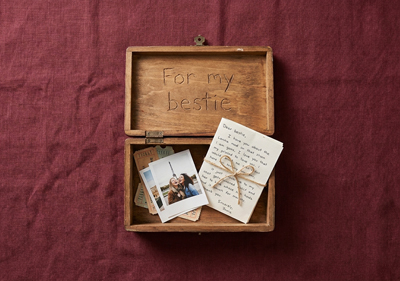
But here’s where it gets more interesting: status competition in gifting isn’t always about money. In a lot of social circles, it has quietly evolved past price tags into something harder to put a number on. People compete over who understands someone better. Who tracked down the out-of-print novel the person mentioned once, offhandedly, years ago. Who pays close enough attention. Who has the kind of access, whether to knowledge or to relationships or to taste, that makes a gift feel genuinely one of a kind. A handmade object can beat an expensive one in this economy if it signals a level of intimacy that money can’t replicate. In this version of the competition, the scoreboard has changed. The question isn’t who spent more. It’s who knows this person best. Which is, in some ways, a more flattering thing to compete over. But it’s still a competition. The audience is still there, watching.
Some relationships are almost immune to all of this. Long friendships, the kind with years of accumulated history and a few hard patches survived together, tend to make modest or uneven gifts feel like nothing. The friendship already knows where it stands. Neither person needs the object to prove anything.
But newer relationships, or relationships with an uncertain charge to them, those are different. Workplace gift exchanges, where people share a building but not necessarily a friendship. In-laws, where belonging has to be earned. Social circles still figuring out their own internal structure. These are the places where gifts start doing extra work, filling in for the clearer sense of mutual standing that hasn’t been established yet. And once a gift is doing that work, the competition is almost automatic, because everyone in the room is essentially asking the same question through their choices: where do I rank here, and how do I make that visible?
Uncertainty is the engine. When people feel secure in a relationship, they stop needing gifts to say anything beyond the obvious. When they’re unsure, the gift absorbs all the pressure. It becomes a measurement tool, a way of staking a position without stating one.
The comfortable gift exchanges tend to happen when neither person needs them to prove anything. When the relationship has already, through time and honesty and a thousand small unremarkable moments, settled the question of what both people mean to each other. In those cases, a bottle of wine is just a bottle of wine. The candle is just a candle. The gift goes back to being about the person receiving it, which is where it was supposed to be from the start.

Article Sources
1. Chihling Liu, Robert V Kozinets, Anthony Patterson, Xin Zhao, Gift Giving in Enduring Dyadic Relationships: The Micropolitics of Mother–Daughter Gift Exchange, Journal of Consumer Research, Volume 51, Issue 3, October 2024, Pages 616–633, https://doi.org/10.1093/jcr/ucae002
2. Itao, Kenji, and Kunihiko Kaneko, Emergence of economic and social disparities through competitive gift-giving, PLOS Complex Systems, Volume 1, Issue 1, 2024, e0000001, https://doi.org/10.1371/journal.pcsy.0000001
3. Bulte, Erwin, Ruixin Wang, and Xiaobo Zhang, Forced gifts: The burden of being a friend, Journal of Economic Behavior & Organization, Volume 155, November 2018, Pages 79-98, https://doi.org/10.1016/j.jebo.2018.08.011

Dattaraj Pai
I’m the founder of Science of Gifts, a website dedicated to helping people find meaningful and thoughtful gifts. With years of experience researching the psychology of gift-giving, I explore how gifts communicate emotions, strengthen relationships, and create lasting memories.
Beyond writing about gifts, I have a background in storytelling and filmmaking, which fuels my passion for exploring the cultural impact of meaningful gestures.