

The Safety Trap: Why We Avoid Sentimental Gifts Out of Fear
You spent hours picking the safe gift. Here's why fear of getting it wrong keeps us from giving the one that would have meant more.

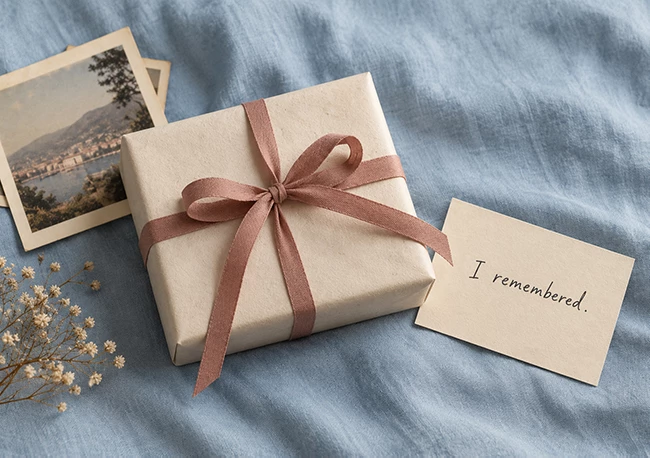
Buying a gift should be simple. You know the person, you know roughly what they like, and you have a budget. Yet three hours in, you’re comparing seventeen versions of the same thing and wondering whether a ceramic mug is too impersonal. So you buy the expensive one. Or the practical one. Or the thing they mentioned wanting six months ago. None of those is a bad choice, but sometimes the real reason we pick them is that they’re hard to get wrong.
A good pair of headphones needs no explanation. A gift card makes no claims about anyone’s personality. Even a bottle of whiskey can be handed over with a casual “I thought you’d enjoy this,” and it reveals very little about the giver. Sentimental gifts are different. They say something about the person giving them, not just the person receiving them. I remember this about you. I noticed that. I thought it mattered. Once you’ve made that claim, you have to wait and see whether the other person agrees.
Imagine buying your father a watch. You spend weeks on movements, case materials, water resistance, and whether the bracelet will pull the hair on his wrist. You end up knowing more about watches than anyone who has ever asked you about watches. Eventually you buy a very good one.
Now imagine giving him a framed photograph of the neighborhood where he grew up, a place he hasn’t visited in decades. You found it because you remembered a story he told you years ago. The print is slightly faded, the frame is plain, and it cost far less than the watch. The watch may be the better product. The photograph may be the better gift. Photographs aren’t inherently sentimental, and watches aren’t inherently impersonal. The photograph simply carries evidence of a particular relationship. You remembered something your father said and did something with it. No specification sheet tells you which childhood memory will make him go quiet for a moment.
We can compare prices, read reviews, check dimensions, and investigate materials. What we can’t do is remove the uncertainty that comes with choosing something personal, though that’s often exactly what we try to do. If you’ve ever spent an evening overthinking a gift, you may recognize the moment when finding something they’d enjoy quietly turns into finding something nobody could criticize. The longer you spend eliminating every possible objection, the easier it is to forget what you were trying to do in the first place.
There’s research behind this. In a 2017 study published in the Journal of Consumer Psychology, Julian Givi and Jeff Galak examined the mismatch between the gifts people choose to give and the gifts people would prefer to receive. Across three studies, they found that givers chose gifts matching the recipient’s interests over sentimental gifts more often than recipients would have wanted. The researchers tied this to uncertainty: givers felt more confident that a preference-matching gift would be liked and less certain about how a sentimental one would land.
That’s the central problem. A gift connected to someone’s favorite band, hobby, or brand feels safer because you already have evidence that they like it. A gift built around a shared memory requires a different kind of prediction. You have to guess whether the memory matters to them the way it matters to you. When you’re afraid of getting it wrong, the obvious move is to pick the option with fewer unknowns.
Starting from an obvious hobby is often the right call. But the same caution tends to steer us toward the most predictable version of it. Suppose your friend loves ancient Rome. You could buy another history book, maybe by a historian he already follows, and he’d probably appreciate it. You could also find a reproduction Roman coin, a map of the empire, or a ceramic cup inspired by ancient drinking vessels. These take a familiar interest in slightly different directions. Instead of adding another book to a shelf, you’re finding a way for the interest to live in his home or daily routine.
Someone who spends evenings reading about military campaigns might like a Roman-themed poster or some Civil War barware. The object doesn’t need to be rare or expensive. It needs to suit the person and have a fair chance of finding a place in their life. That’s the thinking behind my gifts for history buffs, where historical interests can end up on a wall, a desk, or a bar cart instead of staying confined to books and documentaries.
Of course, the gift could still miss. They might already own three similar posters. They might dislike decorative objects. The period you chose might be the one they find least interesting. But you noticed something about them and acted on it, and that counts even if the choice isn’t flawless. Sometimes the revealing detail isn’t a long-standing hobby at all. It’s a story someone keeps retelling, an object they repair instead of replace, a place they bring up whenever a certain subject comes around. You don’t need to turn every passing remark into a shopping opportunity. You just need to notice when something seems worth remembering.
Oddly enough, knowing someone for years doesn’t make this easier. With a new acquaintance, a safe choice is perfectly reasonable, since you don’t yet know enough to get personal. With a parent, partner, or old friend, the accumulated history makes a mistake feel more revealing. You think you should know what matters to them by now. If you misjudge a memory, you might wonder what all those years of familiarity actually taught you. The gift becomes a small test of how well you know someone, even though neither of you asked for an exam.
A practical gift offers an escape from that anxiety. If the recipient isn’t thrilled by a set of kitchen knives, they can still chop vegetables with them. If the headphones aren’t their favorite, they can use them for video calls. A sentimental gift has no such fallback. A framed photograph of someone’s childhood home assumes the place still matters to them. A notebook embossed with an inside joke assumes the joke is still funny. You’re offering an interpretation of a shared history, and the other person gets to decide whether it fits.
The risk of misreading it is real. A place may remind someone of a difficult period. A joke may have run its course. The memory you cherish may be one they no longer think about. But a miss isn’t automatically a disaster. Someone can find your choice slightly off and still appreciate why you made it. They might laugh, explain what you got wrong, or tell you something you didn’t know. The gift can start a conversation instead of delivering a verdict on how well you know them.
We tend to imagine the recipient scrutinizing our decision as closely as we did. Every detail feels significant because we’ve spent so long on it. Psychology has a related idea in the spotlight effect, the tendency to overestimate how much others notice our behavior and appearance. It doesn’t prove that recipients will overlook a disappointing gift, but it’s a reason to question how much scrutiny we imagine. The person opening your present is probably thinking about the occasion, the conversation, or the fact that you showed up. They aren’t conducting the exhaustive review you conducted before buying it.
Money offers another kind of reassurance, and quality does count. Good materials feel better in the hand, last longer, and make everyday use more pleasant. A heavy cast-iron skillet or a well-balanced chef’s knife is a different proposition from a cheap tool that warps or dulls within a month. That matters most when the recipient will use the thing regularly.
But money can also stand in for the harder part of choosing. When we’re unsure what to say, we buy something impressive. When we worry we haven’t paid enough attention, we spend more. A recognizable brand or a premium price gives us something concrete to point to, even when the personal reasoning behind the purchase is thin.
Psychologists Francis Flynn and Gabrielle Adams explored this disconnect in a 2009 paper for the Journal of Experimental Social Psychology. In their experiments, givers consistently expected higher prices to earn greater appreciation, assuming the extra cost would read as thoughtfulness. Recipients didn’t value expensive gifts more than modest ones. That doesn’t make price and quality irrelevant. It just means spending more isn’t a reliable substitute for understanding what someone will value.
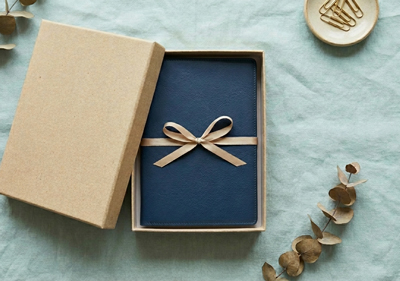
Consider a leather journal. The cover has a satisfying texture, the binding lies flat, and the paper handles ink well. Those qualities are worth having. Now imagine giving someone a notebook with a note saying you remembered they planned to start writing again. It might cost very little, but the choice reflects something you’ve noticed about their life. Ideally you combine the two: a well-made journal chosen because it suits someone’s plans. The mistake is assuming the expense can do all the work.
A personal gift also isn’t the same as a surprise. Sometimes asking someone what they want is the most considerate approach, especially when they have specific needs or would rather choose for themselves. Nobody benefits from a surprise that takes up space they don’t have or creates an obligation they never wanted.
Even so, asking doesn’t mean surrendering every decision. You can respect someone’s preferences and still choose the particular object, material, or detail that makes the gift feel considered. If they tell you they want a certain kind of book, ask about the subject and pick the title yourself. If they want a new wallet, you might find one that suits them and tuck a small amount of money inside, a gesture associated with good fortune in several gifting traditions.
Once given, a gift starts a life of its own. A ceramic cup chosen because someone likes astronomy becomes, over a few years, the cup they reach for every morning. The handle develops a familiar feel, a small mark appears near the rim, and eventually they use it without thinking about why they own it. A notebook gets a bent corner. A leather wallet softens where it rests in a pocket. A framed print becomes part of the room.
Repeated use can attach an object to routines, places, and memories that weren’t part of the original purchase. A gift doesn’t need to carry the whole weight of a relationship on the day it’s unwrapped. Its significance can build gradually, through ordinary use. Material quality helps when it lets an object last, but an object’s eventual meaning can’t be specified in advance. You can choose a sturdy frame to protect a photograph. You can’t decide what that photograph will mean after ten years on someone’s wall.
That’s worth remembering when the search starts to feel like a research project. You don’t need to investigate every aspect of ceramic production before buying a cup for a friend. At some point, more comparison stops improving the decision and starts postponing it. We tell ourselves we’re being meticulous. Sometimes we’re just reluctant to expose our judgment to another person’s reaction.
None of this means romanticizing bad gifts or ignoring what recipients actually want. Start with what you know about the person: what they’ve mentioned in passing, the objects they use regularly, the places they keep returning to in conversation, the interests that make them lose track of time. Look for a connection that feels specific to them. Make sure the object suits their circumstances and is reasonably well made. Then, once you’ve found something suitable, let yourself stop searching.
If you’re comparing the eighteenth version of something you already know is appropriate, ask whether you’re still improving the gift or just trying to feel safer. You can’t research your way to a guarantee that someone will read your intentions the way you hoped. You can only make the best choice available with what you know, then let them respond. When fear of embarrassment makes every decision for you, you end up with the option that reveals the least about what you’ve noticed. Sometimes the better choice is the one that carries a small piece of your shared history, even if you can’t be sure what the other person will make of it.

Dattaraj Pai
I’m the founder of Science of Gifts, a website dedicated to helping people find meaningful and thoughtful gifts. With years of experience researching the psychology of gift-giving, I explore how gifts communicate emotions, strengthen relationships, and create lasting memories.
Beyond writing about gifts, I have a background in storytelling and filmmaking, which fuels my passion for exploring the cultural impact of meaningful gestures.